
The Short Answer
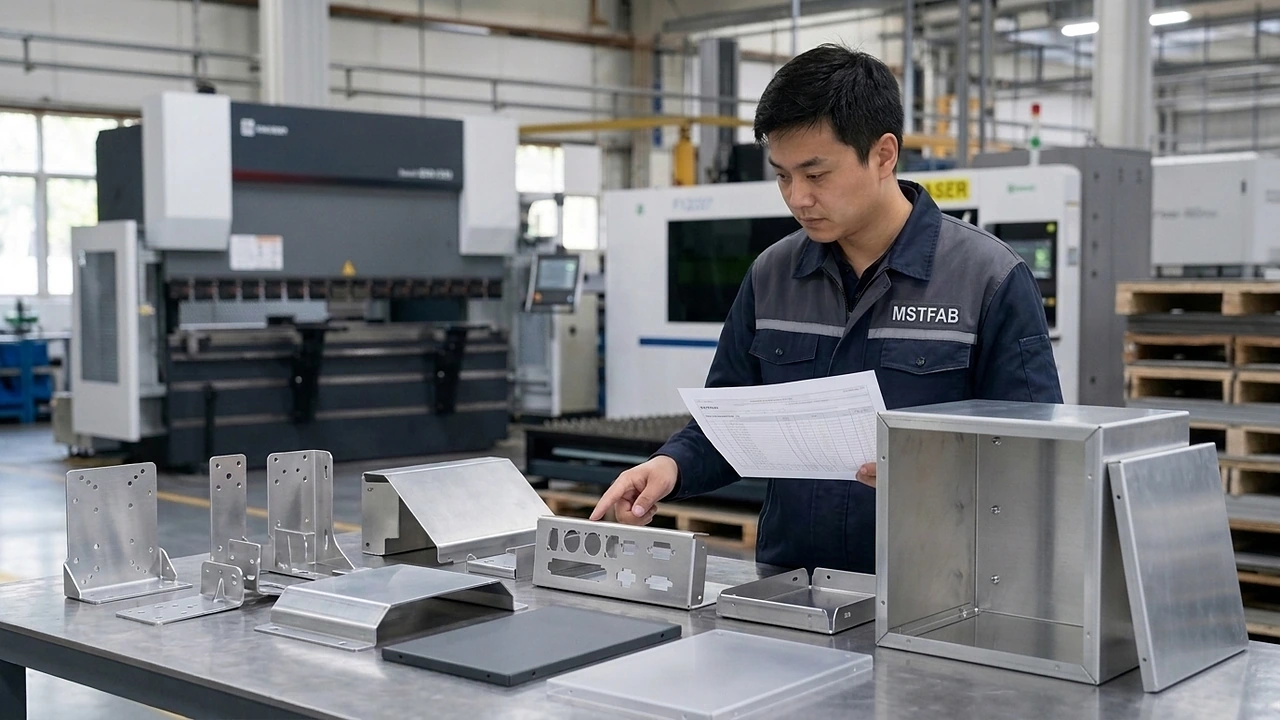
Alloy 5052-H32 is the primary engineering standard for formed aluminum sheet metal enclosures, brackets, and chassis because it combines high ductility on the press brake with strong marine and atmospheric corrosion resistance. Unlike 6061-T6—which frequently cracks at tight 90-degree bends—5052-H32 forms reliably down to 1x sheet thickness inside radii and welds cleanly with 5356 or 4043 filler metal.
Explore this guide
01 / Alloy Selection
Why 5052-H32 outperforms 6061-T6 for bent sheet metal enclosures.
Design engineers accustomed to CNC milling often default to 6061-T6 on every aluminum drawing. When that drawing represents a folded sheet metal chassis with 90-degree return flanges and hems, 6061-T6 creates an immediate manufacturing hazard: its precipitation-hardened crystal structure resists localized plastic stretching, causing orange-peel roughening or outright fracture along the outside bend radius.
Alloy 5052-H32 (an aluminum-magnesium alloy strain-hardened and stabilized) solves this problem. It offers higher fatigue endurance, superior salt-spray corrosion resistance, and smooth plastic flow across standard press brake tooling.
5052-H32 (Forming standard)
Ideal for multi-bend enclosures, U-channels, card cages, and outdoor telecom or marine brackets requiring tight inside bend radii and high weld ductility.
6061-T6 (Machining & flat plate)
Higher yield strength and chip-breaking machinability; best reserved for flat laser-cut mounting plates, heat sinks, or CNC-milled structural blocks.
3003-H14 (Deep drawing & trim)
Very soft and formable for spun, stamped, or cosmetic trim panels, but significantly lower in yield strength than 5052-H32 for load-bearing chassis.
Drawing specification tip: Always include both the alloy and temper on your 2D drawing (write “Aluminum 5052-H32 per ASTM B209” rather than just “Aluminum”) so the shop does not have to pause your quote for material clarification.
02 / Forming & Hole Setbacks
Control inside bend radii, grain direction, and non-marking press brake dies.
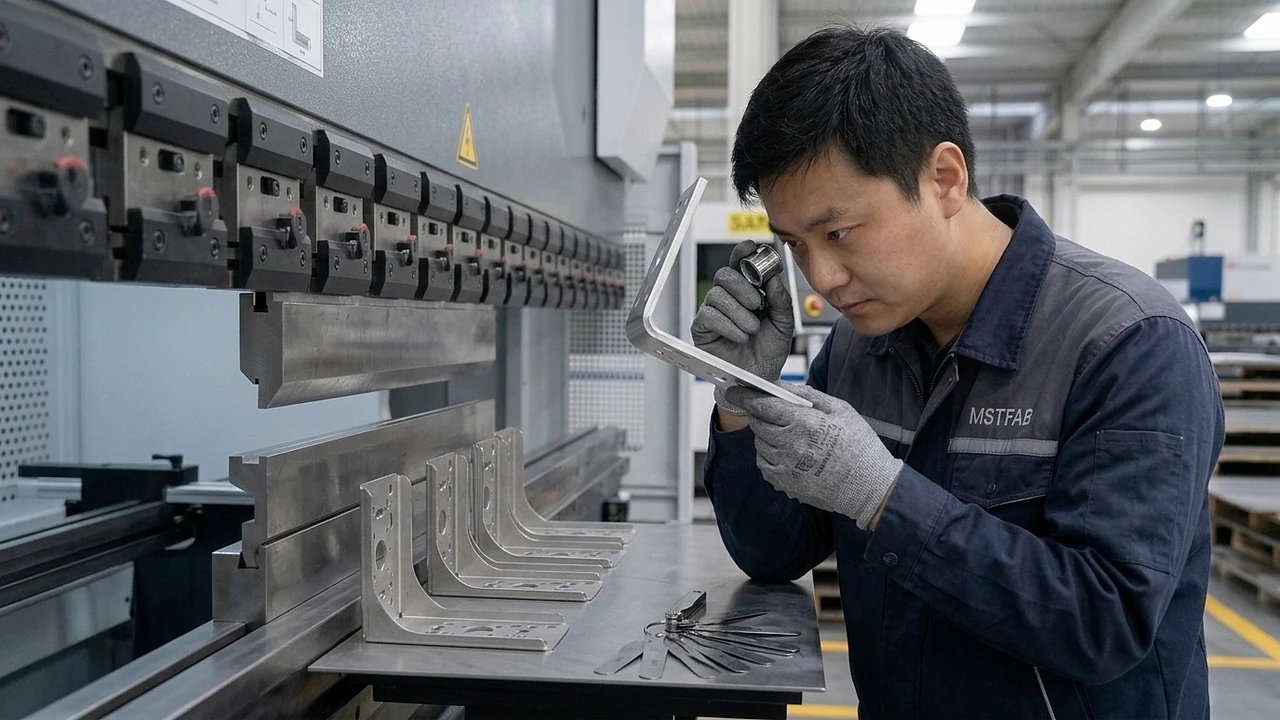
Even with formable 5052-H32 sheet, good press brake results require matching the inside bend radius, V-die opening, and rolling grain orientation to the sheet thickness. Because aluminum is softer than steel, sliding across steel V-die shoulders can also leave visible burnish lines unless protected.
- Recommended inside bend radius: For 5052-H32 thicknesses from 1.0 mm to 3.0 mm, an inside bend radius equal to 1.0x sheet thickness is standard; above 3.0 mm, increase the inside radius to 1.5x–2.0x thickness.
- Hole-to-bend tangent distance: Keep laser-cut holes and PEM mounting cutouts at least 2x sheet thickness plus the bend radius away from the bend line to prevent hole distortion during forming.
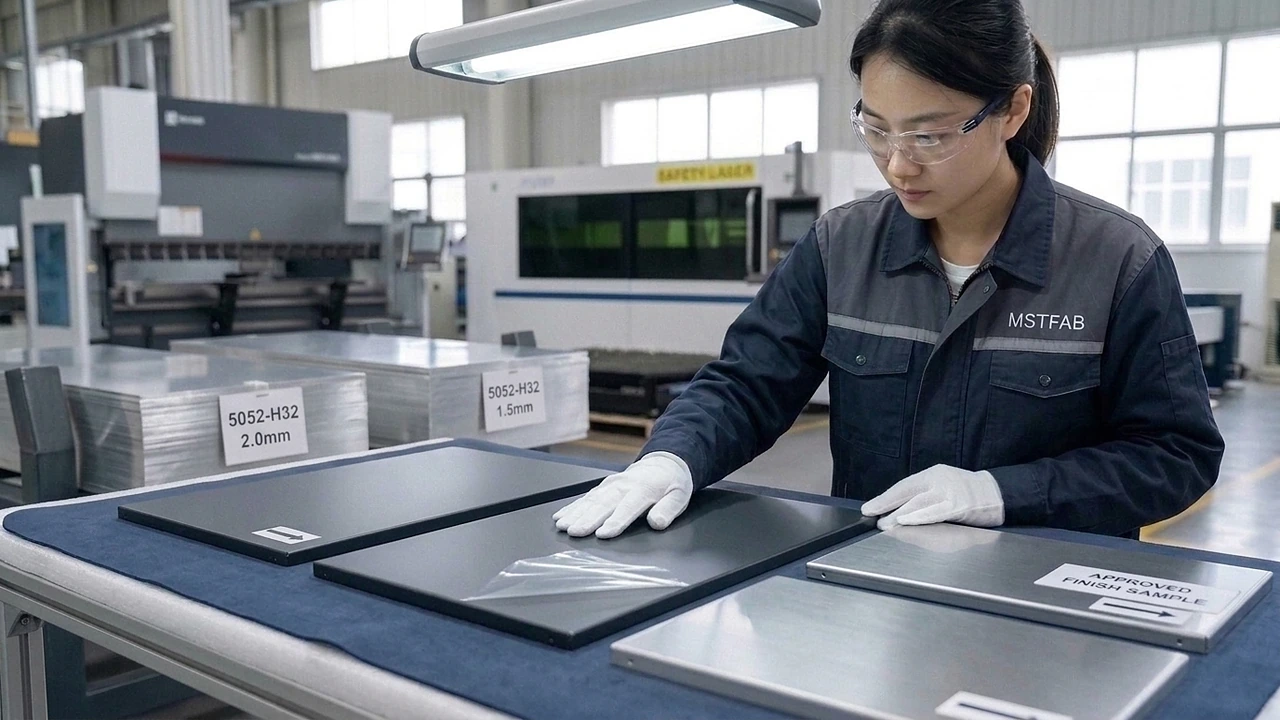
- Non-marking urethane tooling: For panels that will be clear-anodized or brushed without heavy textured paint, use urethane die films or radiused inserts during forming to prevent die shoulder witness marks.
During our CNC sheet metal bending review, we verify minimum flange lengths against V-die widths so short return flanges form cleanly without slipping into the die cavity.
03 / Laser Cutting & Welding
Use nitrogen fiber laser cutting and oxide-cleaned TIG welding for sound joints.
Aluminum reflects infrared energy and forms a refractory aluminum oxide (Al₂O₃) surface layer that melts at roughly 2,072 °C—more than three times the melting point of the underlying 5052 base metal (~607–649 °C). Both cutting and welding processes must manage this oxide layer and high thermal conductivity.
- Cut 5052 sheet with high-pressure nitrogen assist gas on fiber lasers to produce bright, slag-free edges ready for welding or conversion coating.
- Remove surface oxides mechanically with dedicated stainless steel brushes and degrease joints immediately before AC TIG or pulsed MIG/CMT welding.
- Select ER5356 filler rod for maximum shear strength and color match when anodizing, or ER4043 when lower crack sensitivity and smoother weld puddle flow are prioritized.
Because 5052 aluminum expands roughly twice as much per degree Celsius as carbon steel, clamping weldments in rigid copper-backed fixtures and using balanced stitch welds is essential to maintain chassis flatness.
04 / Finishing & Clinch Hardware
Combine conductive conversion coatings, anodizing, and proper clinch fasteners.
5052-H32 responds exceptionally well to both chemical conversion coatings and protective organic or anodic finishes, making it a favorite for electronics chassis and outdoor enclosures.
- Chemical conversion coating (MIL-DTL-5541): Provides low electrical contact resistance for chassis grounding, EMI/RFI gasket lands, and corrosion protection, and serves as an ideal primer under powder coating.
- Sulfuric acid anodizing (MIL-A-8625 Type II): Produces a hard, wear-resistant surface in clear or dyed finishes. Keep in mind that welded seams will show a visible metallurgical halo after clear anodizing.
- Self-clinching hardware installation: With a typical hardness around 60 HB, 5052-H32 accepts standard stainless steel (CLS/CLSS) and aluminum (CLA) self-clinching nuts and standoffs with reliable push-out and torque-out retention.
When both conductive interior grounding and exterior UV weather resistance are required, specify an all-over RoHS-compliant trivalent conversion coat followed by masked exterior polyester powder coating.
05 / Buyer Control Matrix
Verify five manufacturing controls before releasing 5052 aluminum production.
This matrix summarizes what to confirm between buyer engineering and the sheet metal fabricator for 5052-H32 parts.
06 / Cross-Contamination Control
Keep aluminum deburring and weld prep separated from carbon steel dust.
A subtle quality failure in multi-metal fabrication shops occurs when carbon steel grinding sparks or iron sanding dust become embedded in soft 5052 aluminum surfaces. When the aluminum part is later exposed to moisture or sent through an anodizing bath, those trapped iron particles create pinpoint rust stains or pitting defects.
Ensure your supplier uses dedicated stainless steel wire brushes, segregated abrasive belts, and clean press brake tooling wiping routines when running aluminum batches.
Combining clean mechanical prep with alkaline degreasing and acid deoxidizing before conversion coating or powder coating guarantees long-term adhesion and blister-free outdoor service.
07 / Inspection & Export Packing
Verify non-rigid panel geometry and protect soft aluminum surfaces in transit.
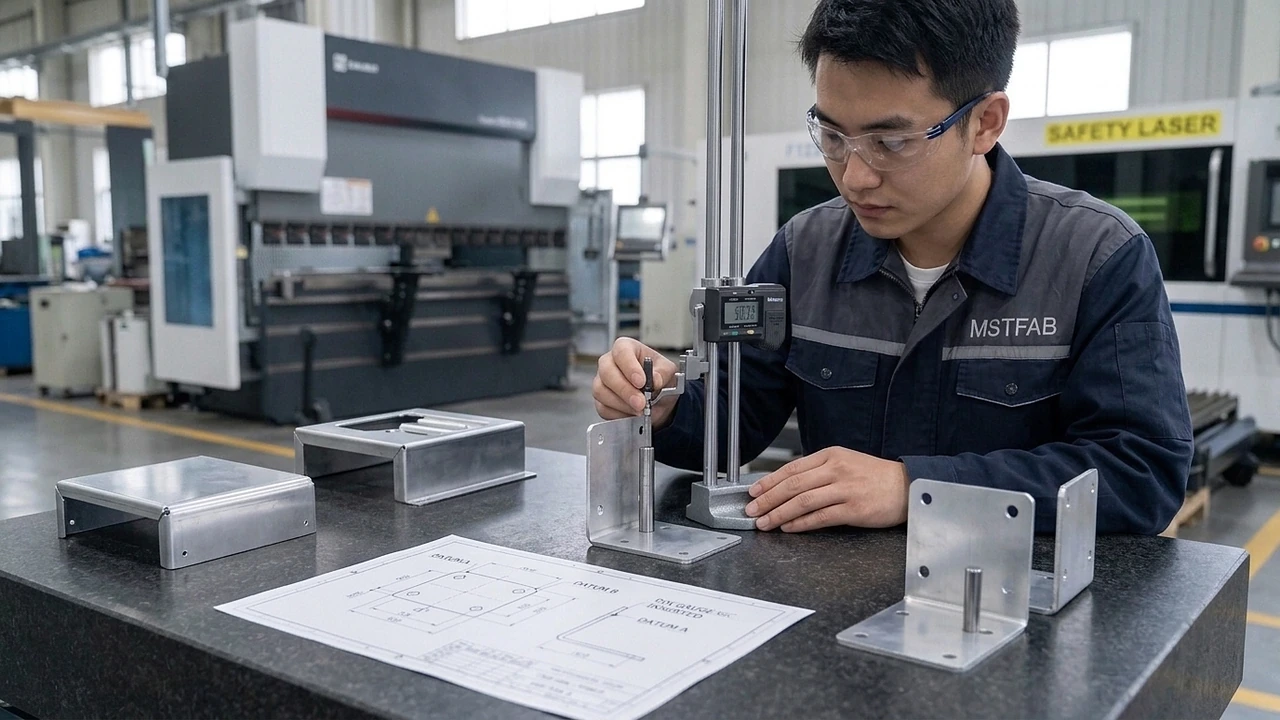
Thin-walled aluminum enclosures and wide U-shape covers can flex slightly in their free state compared with heavy steel frames. Identify on your drawing whether flatness and width tolerances are checked in the free state or restrained on the mounting datum holes.
After first-article and batch inspection, finished 5052 aluminum parts are interleaved with EPE foam, wrapped to prevent chafing, and packed in reinforced export cartons or crates.
Manufacturing scope: MSTFAB manufactures custom 5052 and 6061 aluminum sheet metal parts, chassis, and mechanical enclosures to customer drawings. Electronic integration and final product compliance testing remain the responsibility of the buyer.
08 / Ready-to-Review RFQ
Provide eight specifications for a fast, accurate 5052 aluminum quote.
- Formed 3D STEP modelComplete 3D part or assembly geometry with intended sheet thickness.
- 2D PDF engineering drawingCritical dimensions, hole tolerances, datums, and weld symbols.
- Alloy & temper calloutConfirm 5052-H32 (or note any machined 6061-T6 subcomponents).
- Inside bend radiiVerify ≥ 1.0x thickness radii or authorize DFM bend-radius adjustments.
- Cosmetic surface mapMark Class A visible faces requiring non-marking dies or brushed grain.
- Surface finish & maskingSpecify MIL-DTL-5541 chem-film, Type II anodizing, or powder coat plus masking.
- Self-clinching hardwareFull PEM part numbers, material (stainless vs. aluminum), and install side.
- Prototype & batch quantitiesInitial sample quantity, repeat batch size, and delivery destination.
Clear alloy, bend radius, and finish notes allow our engineering team to validate flat patterns and confirm lead times without back-and-forth delays.
5052 aluminum fabrication questions from OEM buyers
Can we substitute 5052-H32 on a sheet metal drawing that currently calls out 6061-T6?
In most bent sheet metal brackets and enclosures, switching from 6061-T6 to 5052-H32 is the single best DFM improvement you can make. It prevents cracking along 90-degree bends while maintaining excellent corrosion resistance and fatigue strength.
What is the minimum inside bend radius for 5052-H32 aluminum?
For standard air bending on a CNC press brake, designing with an inside bend radius equal to 1.0x material thickness (for sheets up to 3.0 mm) is safe and repeatable across production batches.
Why do welded 5052 aluminum corners look slightly different after clear anodizing?
Anodizing is a transparent conversion of the metal surface into aluminum oxide, not an opaque paint. Because the weld bead (such as 5356 or 4043 filler) and heat-affected zone have a different microstructure and silicon/magnesium content than rolled 5052 sheet, they anodize to a slightly different gray tone. Specify powder coating if welded seams must be visually invisible.
Does 5052 aluminum require pretreatment before powder coating?
Yes. Raw aluminum must be degreased, deoxidized, and treated with a chromate or zirconium/titanium conversion coating before electrostatic powder application so the paint passes cross-hatch adhesion and salt-spray testing.
Which self-clinching fasteners work best in 5052-H32 aluminum panels?
300-series stainless steel fasteners (such as PEM CLS nuts and SOS standoffs) or aluminum fasteners are preferred. They clinch cleanly into 5052-H32 and avoid the galvanic corrosion risks of zinc-plated carbon steel hardware in humid environments.
Can you fabricate hybrid assemblies that combine bent 5052 sheet with machined 6061 blocks?
Yes. We routinely laser-cut and bend 5052-H32 enclosure shells and weld or fasten CNC-machined 6061-T6 bosses, manifolds, and mounting plates into a single subassembly.
Technical references
The following technical standards govern 5052 aluminum sheet properties, welding, and conversion coatings.
Build formed aluminum parts without bend cracking or finish surprises.
Share your 5052 aluminum STEP and PDF drawings for an engineering review covering bend radii, weld design, hardware insertion, and surface finishing.
Upload 5052 Aluminum Drawings →
Have a question first? caroline@mstfab.com
 WeChat Contact
 WhatsApp Me Directly