
LIGHTWEIGHT ALUMINUM ENCLOSURE MANUFACTURING — EXECUTIVE TECHNICAL BRIEF
Weight-critical applications—such as pole-mounted 5G radios, UAV ground stations, portable medical analyzers, and mobile robotics—depend on precision aluminum sheet metal enclosures. This engineering guide provides a quantitative supplier evaluation scorecard and compares 5052-H32 vs. 6061-T6 fabrication rules.
- Alloy Selection Prevents Bend Cracking: Specify 5052-H32 for formed sheet metal enclosures (tight R ≥ 1.0t bends without grain cracking) and reserve 6061-T6 for CNC-machined heatsinks or flat faceplates.
- Oxide Removal Before TIG/Laser Welding: High-tier aluminum fabricators mechanically stainless-brush and chemically deoxidize weld edges within 4 hours of AC TIG or fiber-laser welding to prevent hydrogen porosity.
- Trivalent Chromate Conversion (MIL-DTL-5541 Type II): Clear or gold chem-film preserves electrical conductivity (< 0.8 mΩ/in²) for EMI shielding while acting as an adhesion base for exterior powder coat.
- Stainless Hardware Isolation: Always press 300-series stainless steel (CLS/BSOS) or aluminum (CLA) fasteners into aluminum sheet—never carbon steel—to prevent galvanic corrosion.
Every project at MSTFAB includes a complimentary 24-hour CAD Design-for-Manufacturing (DFM) audit, heat-number-traceable EN 10204 3.1 mill certificates, and a ballooned First Article Inspection (FAI) report prior to volume release.
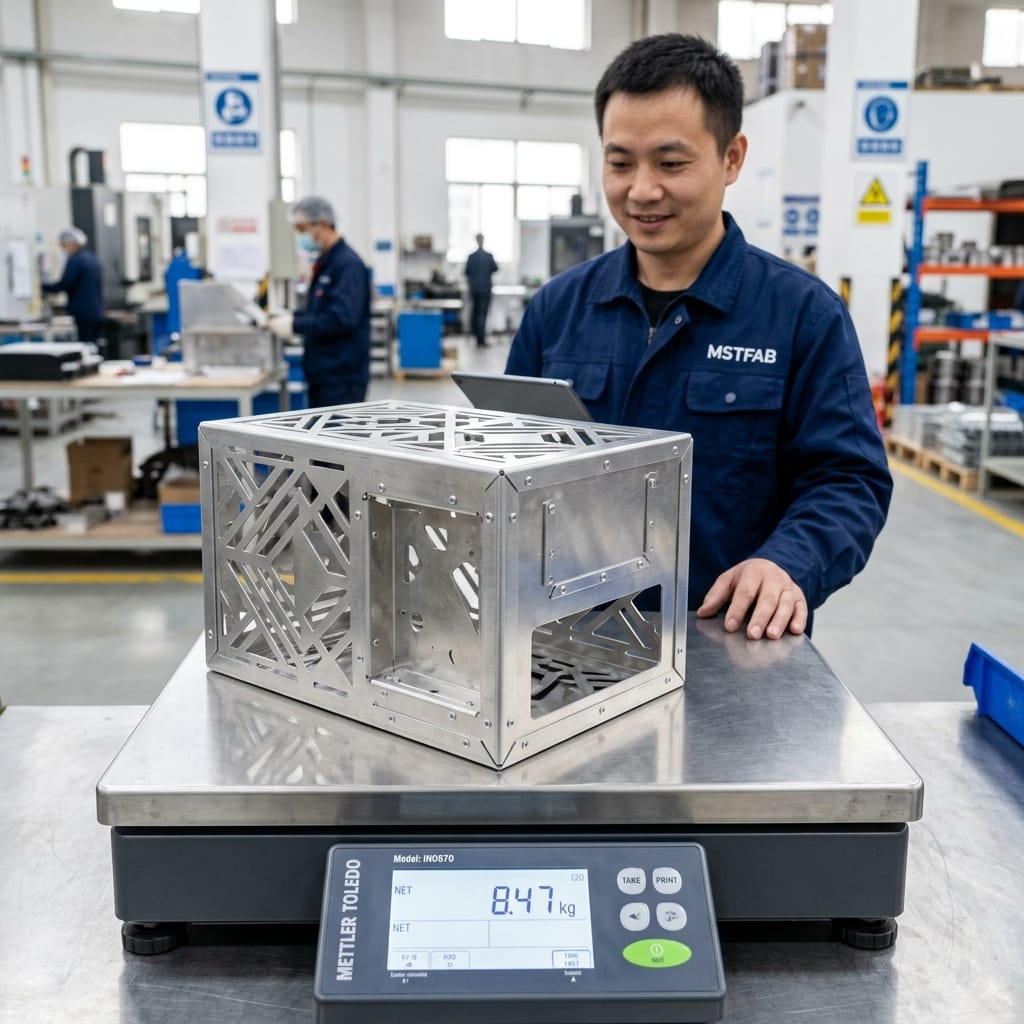
01 / Engineering Specifications & Comparison Matrix
Engineering Specifications, Tolerances & Verification Matrix: Aluminum Sheet Metal Manufacturers for Lightweight Enclosures
Weight-critical applications—such as pole-mounted 5G radios, UAV ground stations, portable medical analyzers, and mobile robotics—depend on precision aluminum sheet metal enclosures. This engineering guide provides a quantitative supplier evaluation scorecard and compares 5052-H32 vs. 6061-T6 fabrication rules. When sourcing custom sheet metal components and enclosures at industrial OEM scale, verbal assurances cannot substitute for drawing-locked process controls. Below is the engineering specification matrix governing raw material selection, dimensional tolerances (per ISO 2768-mK / fH), surface treatment durability, and metrology verification at MSTFAB.
Each parameter is verified during incoming raw material quarantine, in-process CNC stage checks, and final First Article Inspection (FAI) before shipment release:
| Engineering Parameter / Zone | Material & Process Specification | Target Tolerance / Performance Standard | Inspection Method & OEM Value |
|---|---|---|---|
| Primary Enclosure Alloy | 5052-H32 Marine-Grade Aluminum (1.5mm–4.0mm) | Density 2.68 g/cm³ (65% lighter than steel); R_min = 1.0t | OES Alloy Spectrometer + MTC 3.1: Forms 90° flanges cleanly without outer-fiber micro-cracking |
| Machined/Flat Plate Alloy | 6061-T6 Structural Aluminum (3.0mm–12.0mm) | Yield strength 276 MPa; ideal for milled heat-sink baseplates | Hardness Webster / Brinell Test: High stiffness for threaded ports and thermal cold-plates |
| Welding Process | Pulsed AC TIG (ER5356/ER4043) or Hand Fiber Laser Welding | Zero undercut; controlled heat input to limit distortion ≤ 0.5 mm | Dye Penetrant (PT) + IP66 Hydro Test: Produces waterproof, cosmetic seams on thin-gauge aluminum |
| Surface Conversion & Anodize | RoHS Trivalent Chromate (MIL-DTL-5541 Type II) or Type II Anodize | Contact resistance < 5000 μΩ/in² (Chem-film); 10–25 μm (Anodize) | Eddy-Current Meter + Continuity Check: Balances EMI chassis grounding with outdoor salt-fog resistance |
| Cosmetic Forming Control | Urethane Die Film + Grain-Direction Nesting | Bend axis perpendicular to rolling grain; zero V-die scoring | Visual Class-A Surface Audit: Enables clear anodize or brushed finishes without heavy sanding |
02 / Sheet Metal DFM & Structural Controls
Critical Sheet Metal DFM Rules & Field Failure Prevention
Most cost overruns, assembly fit-up delays, and field corrosion failures originate from subtle CAD geometry details or ambiguous drawing notes. Implementing these Design-for-Manufacturing (DFM) controls before releasing your files eliminates tool collisions, thermal warpage, and rework:
Specifying 6061-T6 for Tight 90° Bends
Failure Mechanism: 6061-T6 has low elongation and cracks along the outer bend radius when formed at R < 2.5t–3.0tEngineering Solution: Switch formed chassis shells to 5052-H32 (or 5083-H111 for heavy plates) at R = 1.0t
Verified Outcome: Eliminates scrap, structural cracking, and slow annealing workarounds
Anodizing Welded 5052 Enclosures for Cosmetics
Failure Mechanism: ER4043 weld filler turns dark gray during sulfuric acid anodizing, leaving visible corner halos
Engineering Solution: Use ER5356 filler wire for color match, or specify chromate conversion + fine-texture powder coat over welded corners
Verified Outcome: Delivers uniform cosmetic appearance across welded assemblies
Thin Aluminum Door Warpage During Welding
Failure Mechanism: Aluminum’s high thermal expansion (23×10⁻⁶ /K) and conductivity cause thin panels (<1.5 mm) to oil-canEngineering Solution: Increase shell gauge to 2.0 mm, add perimeter return flanges, and use copper heat-sink clamping jigs
Verified Outcome: Maintains door flatness within ≤ 1.0 mm/m for reliable IP65 gasket compression
Manufacturing Scope Boundary: Insufficient Thread Engagement in Soft Aluminum: Direct tapped holes in 2.0 mm aluminum strip easily after 3–5 service cycles — Engineering Fix: Install 304 stainless steel self-clinching nuts (CLS) or helical wire thread inserts (Helicoils) (Increases pull-out and torque capacity by over 300%). MSTFAB manufactures custom sheet metal parts and empty mechanical enclosure shells strictly to your 3D STEP and 2D PDF drawings.
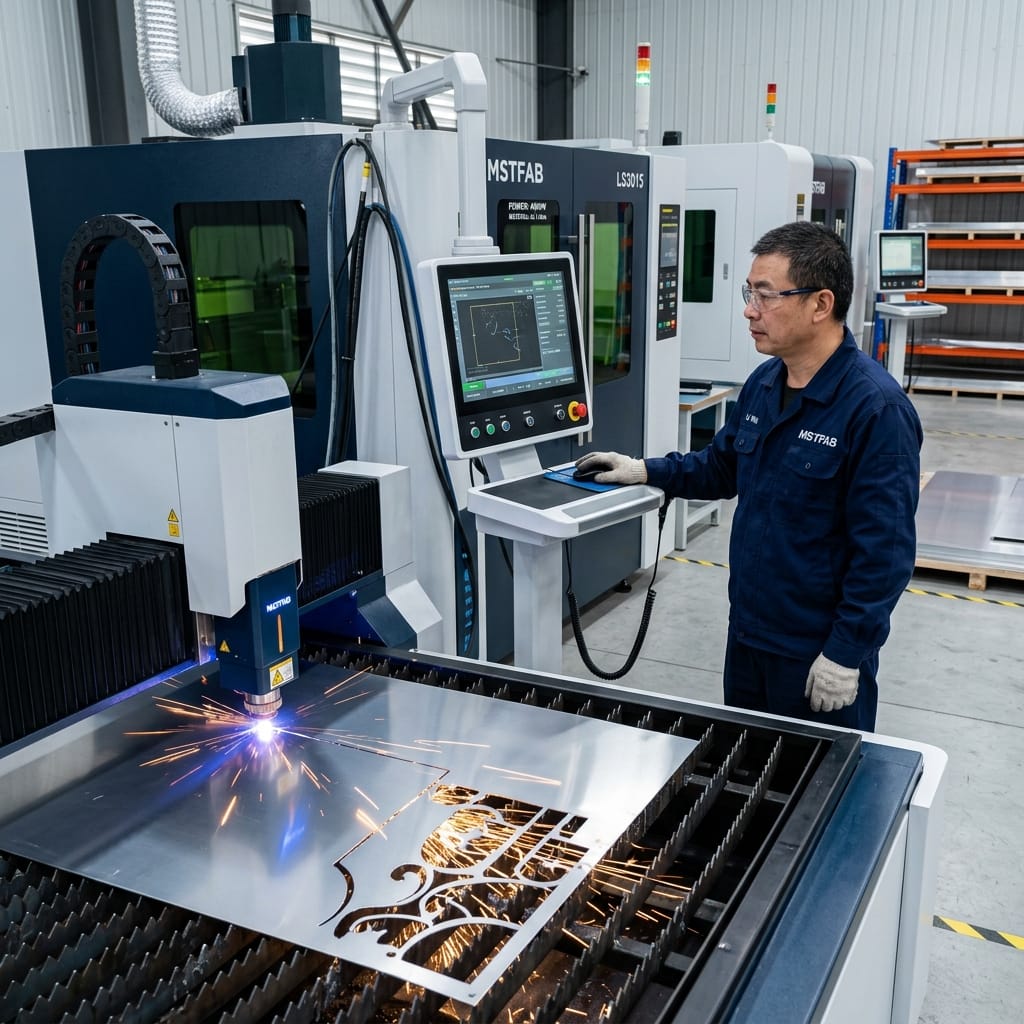
03 / Real Production Case Study & Process Control
Real Production Case Study: Pole-Mounted 5G Massive MIMO Remote Radio Head Enclosure (420×320×140 mm)
Project Profile: Batch Size: 500 Units | Material: 2.0mm 5052-H32 Shell + 6.0mm 6061-T6 Heat Sink Backplate | Weight: 4.1 kg (vs 11.8 kg in steel)
OEM Engineering Challenge: A telecom OEM needed to cut tower-mount enclosure weight by 60% while maintaining IP66 weatherproofing, 1,000-hour salt-spray durability, and <0.02 Ω EMI gasket contact resistance.MSTFAB Manufacturing Solution: MSTFAB fabricated the main shroud from 2.0 mm 5052-H32 joined to a CNC-skived 6061-T6 backplate via friction-locked stainless fasteners and continuous laser-welded perimeter seams. The entire housing received MIL-DTL-5541 Type II trivalent chromate, precision masking on the EMI groove, and C4-rated UV-stable white powder coating.
- Total Enclosure Mass Reduction: 65.2% lighter (4.1 kg vs 11.8 kg steel baseline)
- IP66 & Pressure Decay Test: 100% pass at 15 kPa for 60 seconds
- Salt Fog Corrosion Resistance: 1,000 hrs ASTM B117 with zero blistering
- EMI Seam Transfer Impedance: < 0.015 Ω across masked trivalent chromate flange
Every production lot is archived with locked CNC laser nests, press-brake bend programs, weld fixture setups, and signed golden samples to guarantee identical repeatability across multi-year reorders.
04 / Quality Verification, Traceability & Surface Finishing
4-Stage Manufacturing Workflow, Surface Treatment & Metrology Control
To maintain Cpk ≥ 1.33 on critical-to-quality (CTQ) dimensions from prototype through series production, MSTFAB executes a closed-loop four-stage fabrication protocol:
Step 01 — Grain-Aligned Nesting & High-Pressure Nitrogen Laser Cutting: 5052-H32 sheets with dual-side PVC protective film are nested perpendicular to critical bend lines and laser-cut with 18-bar nitrogen to prevent bottom dross.
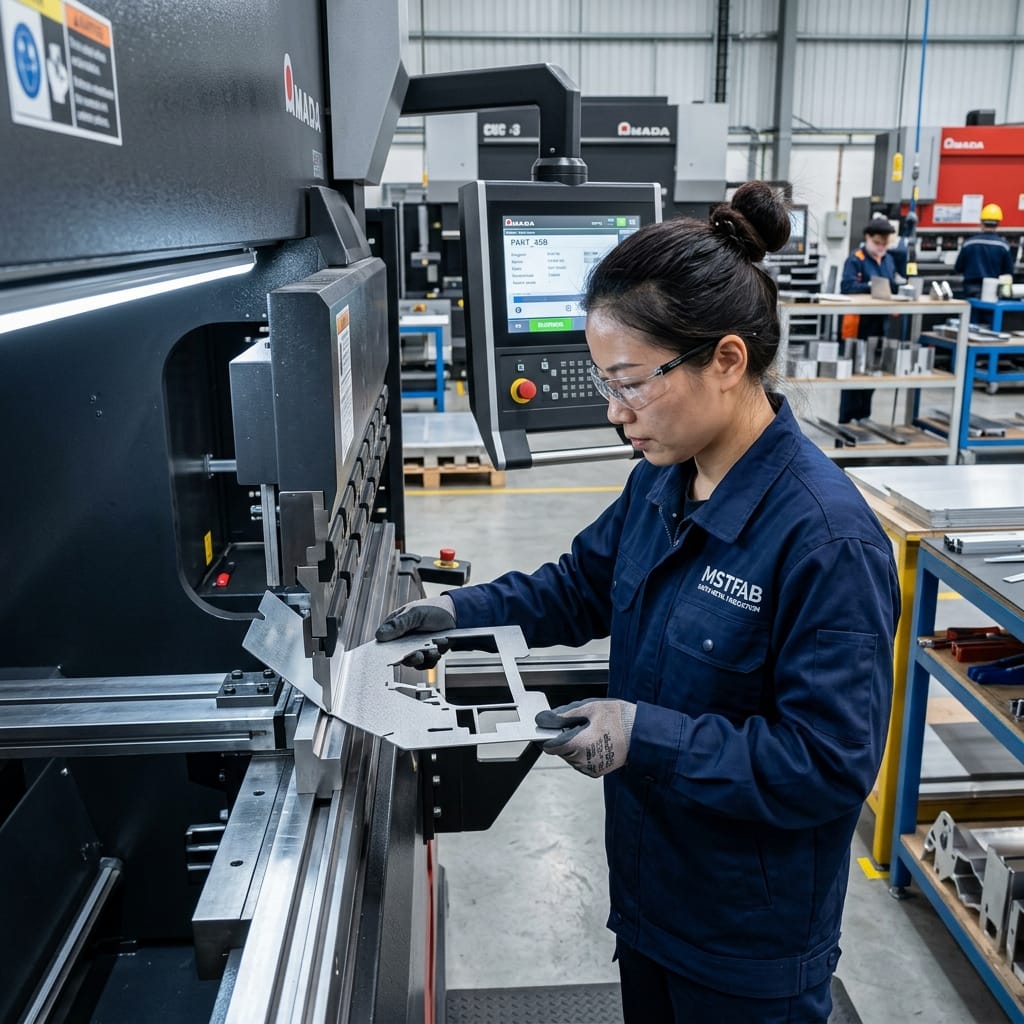
Step 02 — Non-Marring Urethane-Die CNC Bending: Panels are formed over polyurethane die pads on CNC press brakes, holding ±0.15 mm flange accuracy without leaving tool witness lines.
Step 03 — Oxide Removal & Pulsed AC TIG / Laser Seam Welding: Joint edges are stainless-brushed and acetone-wiped immediately prior to pulsed AC TIG or fiber laser welding inside copper chill-block fixtures.
Step 04 — Trivalent Alodine Conversion, Masking & Powder Coating: Enclosures undergo alkaline cleaning, acid deoxidizing, RoHS trivalent chromate bath, selective EMI masking, and architectural polyester powder curing.
All raw sheets (SPCC, SGCC, SECC, SUS304/316L, Al 5052-H32/6061-T6) are verified via optical emission spectrometry (OES) or XRF upon arrival and linked by barcode to your purchase order.
Prior to export crating in ISPM-15 fumigated plywood boxes, our quality lab conducts ballooned dimensional FAI checks, dry-film thickness (DFT) mapping, ASTM D3359 cross-hatch adhesion testing, and ground-continuity verification.
05 / 8-Point OEM RFQ Checklist & Topic Cluster Hub
OEM Engineering RFQ Checklist & Connected Fabrication Hubs
Include these eight drawing and specification controls in your RFQ package so our engineering team can lock down tooling, material traceability, and inspection fixtures on day one:
- RFQ Requirement 013D STEP model and 2D PDF drawing with alloy & temper callouts (5052-H32 vs 6061-T6)
- RFQ Requirement 02Cosmetic surface map indicating brushed, anodized, or powder-coated Class-A faces
- RFQ Requirement 03Conversion coating specification (MIL-DTL-5541 Type II trivalent clear/gold chem-film)
- RFQ Requirement 04Masking diagram for EMI gasket tracks, RF connector bulkheads, and ground studs
- RFQ Requirement 05Welding standard (AWS D1.2 / ISO 10042) and leak-testing requirements (IP65/IP66/IP67)
- RFQ Requirement 06Fastener BOM specifying stainless steel (CLS/BSOS) or aluminum self-clinching hardware
- RFQ Requirement 07Target weight budget and thermal dissipation interface flatness tolerances
- RFQ Requirement 08Prototype batch size, annual forecast, and export protective packaging specs
Explore Connected Sheet Metal Fabrication Services & Enclosure Hubs
CNC Press Brake Sheet Metal Bending & Forming
TIG / MIG / Robotic Sheet Metal Welding Services
Powder Coating, Passivation & Anodizing Finishes
Precision CNC Machining & Hybrid Metal Assemblies
Custom Electrical Enclosures & OEM Equipment Shells
Upload 3D STEP + 2D PDF for 24-Hour DFM & Price Quote
ISO 9001 & IATF 16949 Certified Factory Fact Sheet
06 / OEM Buyer & Engineer FAQ
Frequently Asked Questions: Aluminum Sheet Metal Manufacturers for Lightweight Enclosures
What is the best aluminum alloy for bent sheet metal enclosures?
5052-H32 is the industry benchmark for sheet metal enclosures. It offers high fatigue strength, superior marine corrosion resistance, and forms cleanly at a 1x material thickness inner bend radius without cracking.
How do you evaluate aluminum sheet metal manufacturers on quality?
Verify five capabilities: (1) high-pressure nitrogen fiber laser cutting, (2) urethane-film mar-free press brake tooling, (3) dedicated stainless brushing/chemical deoxidizing before AC TIG or laser welding, (4) in-house or certified MIL-DTL-5541 trivalent chromate lines, and (5) CMM First Article Inspection.
Can you combine CNC-machined 6061-T6 plates with formed 5052-H32 sheet metal?
Yes. MSTFAB routinely fabricates hybrid enclosures that pair CNC-milled 6061-T6 thermal baseplates or front bezels with lightweight formed 5052-H32 sheet metal covers.
Does anodizing conduct electricity for EMI grounding?
No—anodized aluminum oxide (Al2O3) is an electrical insulator. If your enclosure requires EMI shielding or chassis grounding, specify trivalent chromate conversion (chem-film) or selectively mask the grounding pads before anodizing.
How do you prevent weld distortion on thin aluminum enclosures?
We use pulsed AC TIG and handheld fiber laser welding inside rigid copper chill-block fixtures, which absorb excess heat and hold panel flatness within ±0.5 mm.
What is your typical lead time for custom aluminum enclosures?
Prototypes with chem-film and powder coating ship in 7–10 days, while production runs of 50–1,000+ units ship in 15–20 days.
International Standards & Engineering References
- ISO 2768-1 / 2768-2 — General Linear, Angular and Geometrical Tolerances for Sheet Metal Fabrication
- IEC 60529 / NEMA 250 — Degrees of Protection Provided by Enclosures (IP Code & Environmental Sealing)
- ISO 9001:2015 & IATF 16949:2016 — Quality Management Systems & Production Part Approval Process (PPAP)
Ready to Quote Your Custom Sheet Metal Enclosure or Fabrication Project?
Upload your 3D STEP models and 2D PDF drawings. MSTFAB will review your tolerances, material specs, and DFM details to deliver a transparent factory quote within 24 hours.
Request Your 24-Hour DFM & Custom Quote →
Direct engineering desk: caroline@mstfab.com | ISO 9001 & IATF 16949 Certified Factory in Guangzhou, China
 WeChat Contact
 WhatsApp Me Directly